




KEY TAKEAWAYS
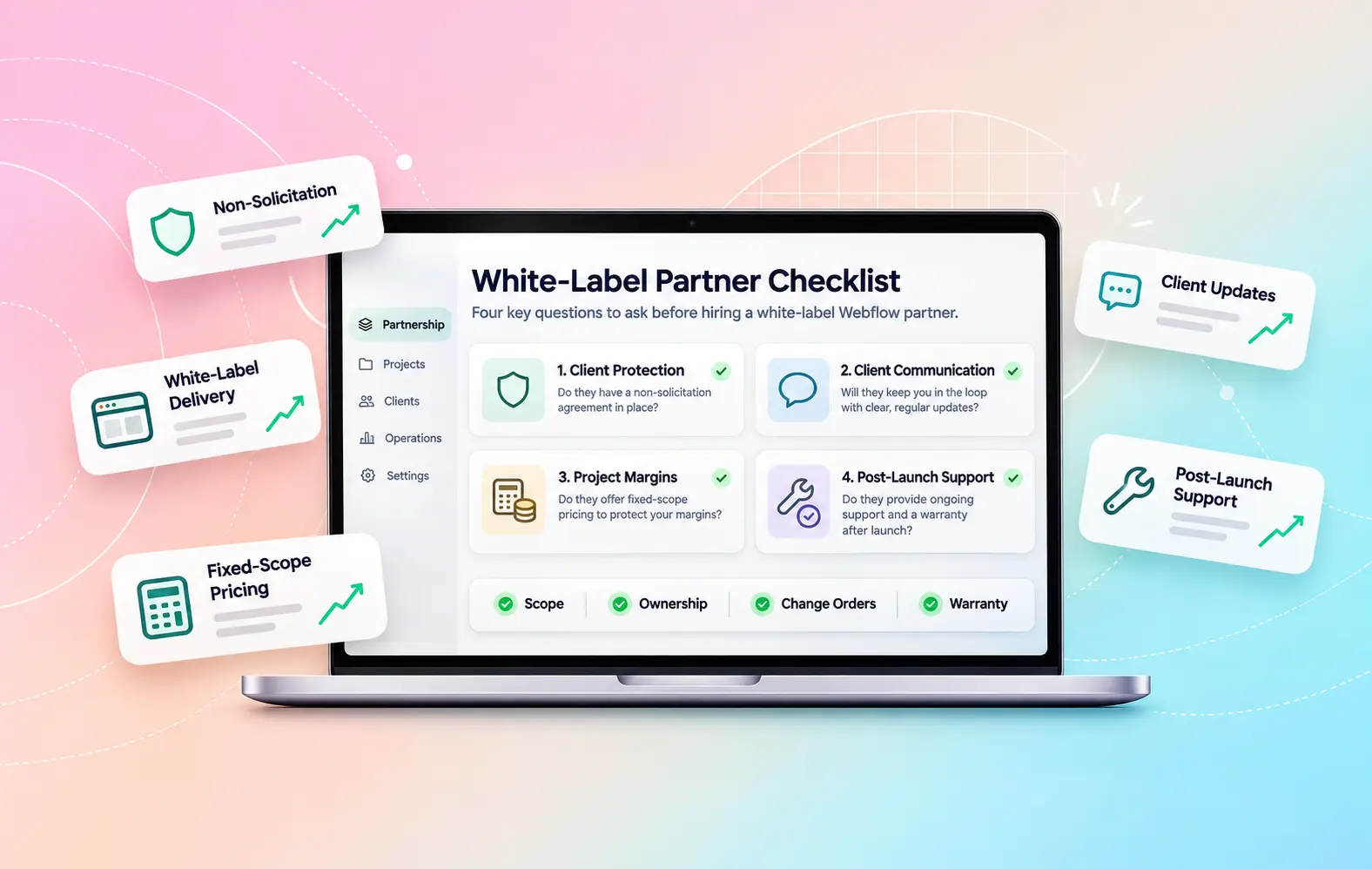
- Ask for non-solicitation with a defined term, not a non-compete. One protects your client, the other costs you price leverage.
- A fixed number against a defined scope, before you quote your client. Hourly quoting moves the overrun onto your margin.
- The question that separates a vendor from a partner: tell me about a project that went wrong.
Four questions, and the order matters
Most agencies that call us about white label Webflow development open with the same question: what do you charge. It is the wrong one to lead with, because the rate only matters after you know four other things.
Here is what an agency principal is actually deciding when they hire a white label Webflow partner, in the order the risk shows up. Ask these of us, and ask them of whoever else you are talking to.
1. Will you take my client?
This is the fear nobody says out loud on the first call, and it is reasonable. You are about to introduce a production team to an account you spent a year earning.
What to ask for: a non-solicitation clause with a defined term. Not a vague promise of professionalism. A written commitment that the partner will not approach your client directly, for a stated number of months after the engagement ends.
Two things to watch. First, a partner who offers this before you ask has thought about the relationship; one who treats it as an unusual request has not. Second, be careful what you ask for in return — some agencies try to impose a non-compete that bars the partner from working in their vertical at all. That is not protection, it is a different deal, and a good partner will decline it. Non-solicitation protects your client. A non-compete protects nothing and costs you leverage on price.
Ask also what happens to the client relationship if your agency and the partner stop working together. The files, the hosting, the Webflow project and the client contact should all sit on your side of the line, documented, before the first invoice.
2. Will you make me look bad in front of my client?
The scenario that actually hurts is not a missed deadline. It is this: you are in a call with your client, alone, and they ask something technical you cannot answer. Can we connect this to our CRM. Why is the staging site slower than the old one. What happens to our rankings when we launch.
Every white label arrangement handles the easy version of this. The question to ask is how they handle the version where you have twenty minutes of notice, or none.
What to ask for:
- A written summary before each client-facing milestone, in language you can read out loud. Not a changelog. A short note on what changed, what it means for the client, and what is coming next.
- A named person, not a ticket queue. You should know who is building your client's site, and be able to reach them.
- Whether they can join a call as part of your team, under your brand, when the question is too technical to relay. Some white label partners do this. Many will not. It is worth knowing before you need it.
The underlying test is simple: does the partner understand that your reputation is the product here, not the website.
3. Does the margin actually work?
This is where most white label Webflow agency relationships quietly fail, and it is rarely about the hourly rate.
The question is not what they charge. It is whether you can quote your client before you know what the build costs you.
If the partner quotes hourly, you are the one carrying the overrun. You gave your client a number, and every hour of discovery that was not in the estimate comes out of your margin. If the partner quotes a fixed scope with a written change-order process, the risk sits with them, which is where it belongs — they are the ones who can estimate the build.
So ask: will you give me a fixed number against a defined scope, before I quote my client? And then ask the follow-up that reveals how they work: what counts as a change order, and who decides.
A partner with a clear answer has run this before. A partner who says "we will figure it out as we go" is telling you the overruns will be yours.
4. What happens when something goes wrong?
Not if. Every build has a defect that surfaces after launch, and the only question is who pays for it.
Ask two things. Are defects fixed at your cost, and for how long after launch? A partner that stands behind the work for a defined window is pricing that into the quote, which is honest. One that treats every post-launch fix as new billable work has moved the risk onto you.
And what happens to the client's site if we stop working together mid-project? You want the answer to be that the Webflow project, the assets and the documentation transfer to you, and that it is already written down. Not improvised at the worst possible moment.
Where we would tell you not to hire us
A page like this is easy to write when every answer is yes. Here is where ours is no.
When the scope has not been agreed with your client. If you want us to start building and discover the requirements along the way, the estimate will be wrong and the margin will disappear. We would rather spend a week defining scope with you first, or decline.
Rescue work where the original developer is still involved. Taking over a half-finished Webflow build is fine. Taking it over while someone else is still in the project, with a different view of how it should work, is not. That ends badly for everyone, and the agency in the middle takes the damage.
Overflow at a discount. If you have an in-house team and need extra hands at a lower rate during a busy quarter, that is a staffing problem, not a white labeling one. Contract staff will serve you better and cost less.
Very small single-page builds. The coordination overhead of a white label relationship — scoping, written summaries, change orders — costs more than the build is worth. Below a certain size you are better off doing it yourself or using a template.
The question that separates a vendor from a partner
If you ask only one thing, ask this: tell me about a project that went wrong, and what you did about it.
A vendor will tell you it has not happened. A partner will tell you the story, including the part where it cost them money. The second answer is the one you want, because the relationship you are buying is not the build. It is what happens on the day the build is not enough.
How we answer these
Our answers to all five, the platforms we build on, and the cases where we say no are on our white label page. If the answers fit, the next step is a scoped conversation about one real project, not a capabilities call.
Ask it on a call. A Growth Audit also shows which pages already bring in customers and what to fix first.


Keep reading



Not sure where your site is losing customers?
A Growth Audit tells you which pages already work, which ones leak, and what to fix first. Before you commit to a redesign.
Stop letting technical debt limit your revenue. Get a 30-minute strategic diagnostic of your digital infrastructure. No fluff, just strategy.