

%201.png)


Google Ads Attribution reveals which campaigns actually drive customers.
Google Ads Conversion Tracking measures leads instead of empty clicks.
Google Ads Optimization improves ROI before increasing your budget.
Google Ads Management focuses spending on campaigns that generate revenue.
Why more budget stops working
Most accounts can report impressions, clicks and form submissions. None of those is revenue.
Google Ads spends more where it sees success, and the success signal it sees is "form submitted".
So it finds more people who submit forms. Some of them were never going to buy.
Form submissions
Closed jobs
Cheapest cost per lead
Highest revenue per dollar
Volume of inquiries
Inquiries that convert
The account is not broken. It is doing what it was told, and the instruction was wrong.

.gif)
What to fix before you spend
Four things, and none of them is a campaign.
.png)
1. Conversion tracking on the right event
Not page views or button clicks. The completed submission.
2. A lead source that records itself
Every inquiry arrives tagged with where it came from, without anyone remembering to ask.
3. Offline conversion import
When a lead becomes a paying job, it syncs back to Google Ads automatically.
4. A landing page that can measure
ds pointed at a site with no tracking will spend budget and teach you nothing.
How much should you spend?
Less than you think, until the four items above exist. Here is one account after measurement was in place:
59% less spend. 24% more revenue. Not because the ads improved, but because the account could finally tell which campaigns produced work.
The budget question answers itself once attribution works. Before that, any number is a guess with a decimal point.
How to check your own account in ten minutes
Four checks, no tools required.
1. Ask which campaign produced your last five customers
By name. If the answer is a percentage or a range, the attribution is broken.
2. Open your conversions list
Count how many are form fills and how many represent revenue. If they are all form fills, the account is optimizing toward the wrong thing.
3. Compare cost per lead to cost per job.
If you only know the first, you do not know what a customer costs.
Transform your website with us
Improve your online presence with our expert website design services.

Where we fit
We build measurement first and campaigns second. That means the first weeks produce no leads, which is uncomfortable and is the point.

Intuitive
Our websites are designed with intuitive functionality, making it easy for users to navigate and interact.

Visually
Discover the perfect balance between creativity and efficiency.
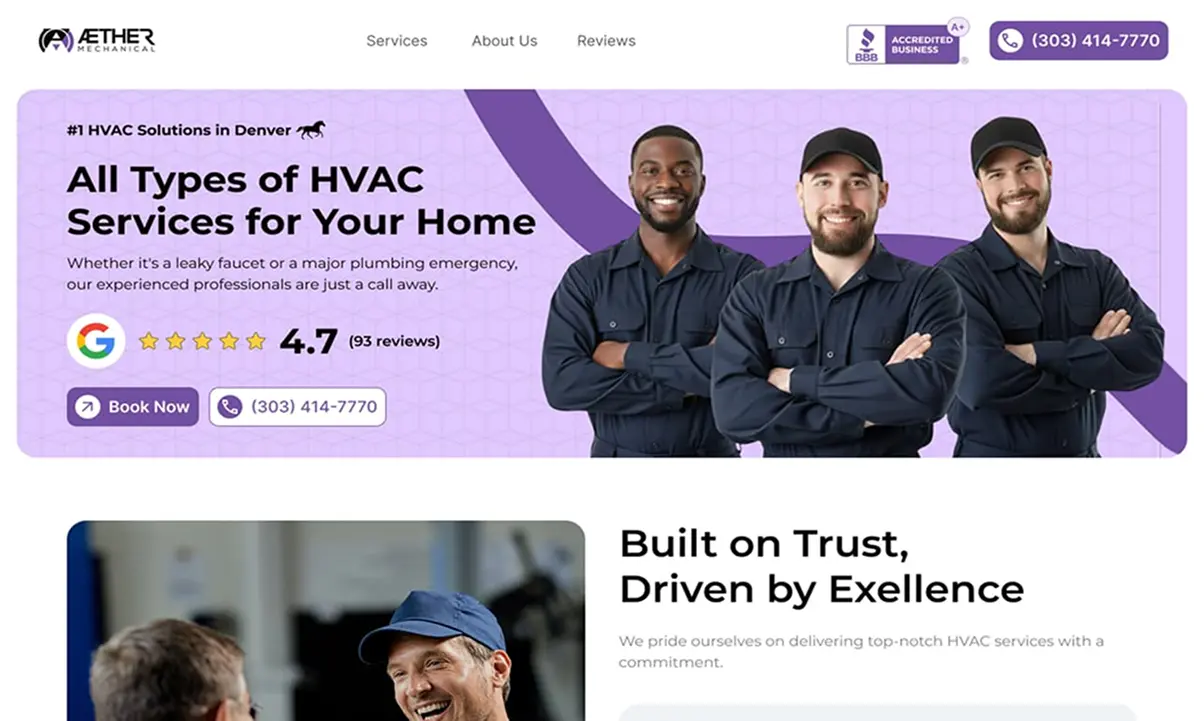
The account in the table is an HVAC contractor in Denver who had completed 634 jobs the previous year with exactly one lead source recorded. Three months on tracking and attribution before a single campaign ran.
It returned 5.8× on total investment, fees included. We count our own fee, because return on ad spend leaves out what the agency charges and a business owner cannot decide anything with that number.

Testimonials
Validation from the high-ambition brands we’ve helped scale
"The transformation of our digital presence has been remarkable. Our new website finally reflects the high level of professional service we provide. The user experience is intuitive, and the new design has significantly improved how clients in the Denver area perceive and interact with our brand."

Testimonials
Validation from the high-ambition brands we've helped scale
"The transformation of our digital presence has been remarkable. Our new website finally reflects the high level of professional service we provide. The user experience is intuitive, and the new design has significantly improved how clients in the Denver area perceive and interact with our brand."
Project portfolio
Results-driven projects we've helped grow



Modern Design
We transform outdated designs into modern, visually stunning websites that captivate your visitors.

Results-Driven Architecture
This redesign goes beyond visuals; we restructure key elements to guide users toward conversion, transforming a static site into a powerful engine for growth and profitability.

FAQs
Find answers to frequently asked questions to help you quickly get the information you need.
It is, once you can measure which clicks produce revenue. Without that it is a spend with no feedback loop.
Not always. You need conversion tracking and a self-recording lead source, and both can be added to most existing sites.
Yes. We keep the campaigns that produce revenue and rebuild the measurement underneath.
Measurement takes two to four weeks, campaign learning another four to six. An agency promising results in month one is not building attribution.
Among others. Trades and local services are where the measurement problem is worst and where fixing it changes the most.